As part of the 2025 Winter School Justice by Design, students were immersed in six distinct studios—each rooted in a specific unjust reality, and each offering a unique method, attitude, and lens through which to explore spatial justice and radical spatial imagination.
Rather than prescribe solutions, the studios invited students to radically reimagine, question, and challenge. Together, they formed a constellation of inquiries into how design might resist domination, reclaim agency, and foster more just ways of relating to space, place, and each other.
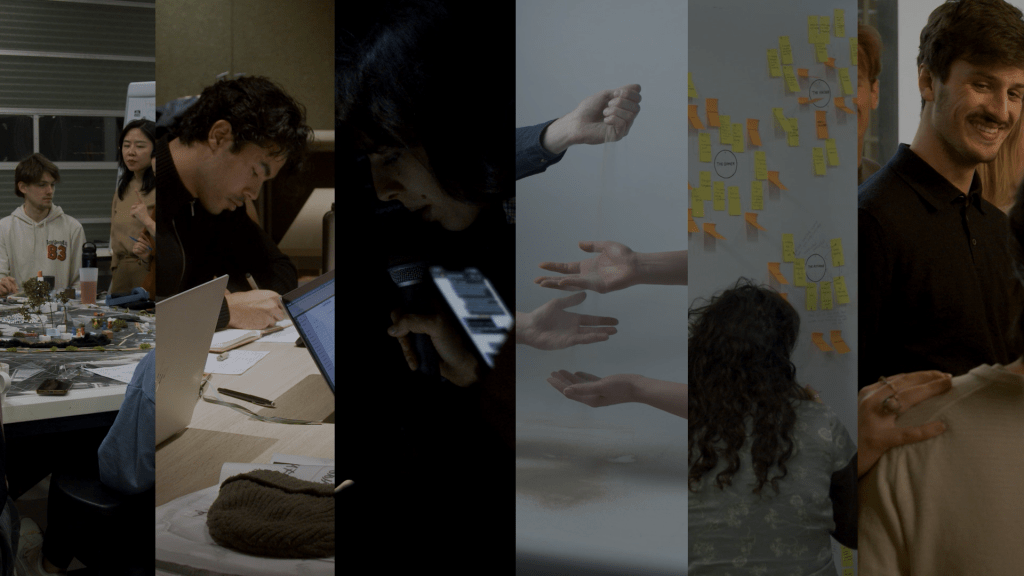
Here’s how each studio unfolded:
Studio 01: Justice by Design: a constellation of attitudes.
Tutor: Irene Luque Martin & Johnathan Subendran
This studio explores the agency of designer attitudes through critical reflexivity across five case-based studios. Participants engage in a journey to examine the values, methods, and practices that shape these attitudes, drawing from past, present, and future possibilities. In three key roles—journalists, researchers, and composers—they will investigate the evolution of design attitudes, conduct interviews and fieldwork, and create a visual narrative to communicate their findings. The studio aims to integrate these insights into a conceptual framework, illustrating how diverse designer attitudes contribute to advancing justice by design. This process fosters an understanding of how attitudes relate and manifest.
Skills to develop: Critical reflexivity and reflection
Attitude: The reflector / The exposer
Studio 02: Enacting matriarchal patterns. Unlocking the radical imaginary.
Tutor: Caroline Newton & Amber Coppens
This studio invites participants to explore matriarchal patterns of liberation in contrast to colonial and patriarchal oppression. Through theatrical performance and the concept of mind-body-territory, participants will engage with the radical imaginaries and decolonial struggles of the Sahrawi people. Focusing on enactment over embodiment, the workshop connects spatial dynamics with personal and collective experiences to foster inclusive, community-driven design practices. Participants will reinterpret and reimagine these patterns through physical, emotional, and reflective processes, delving into spatial justice issues. Outputs include a screenplay of performances, visual documentation, and reflective writings, promoting an understanding of matriarchal resilience in spatial planning.
Skills to develop: Enactment and performative exploration of spatial concepts, critical reflection, visual documentation, and drawing the radical imaginary.
Attitude: The activator
Studio 03: UNTOLD: Counter-narratives of undoing
Tutor: Luisa Maria Calabrese & Raquel Hadrich
Studio description This studio examines socio-environmental injustices in land reclamation, with a focus on Manila Bay, where “green” developments displace communities and ecosystems. It challenges the designer’s complicity in perpetuating inequity, dismantling the myth of Dutch land reclamation expertise as a universal solution. Rooted in “undoing,” the studio deconstructs dominant narratives and confronts designer neutrality. The focus is on movement improvisation and choreography, allowing students to engage with conflict and injustice through embodied strategies. Speculative mapping is used to challenge power structures, and the final outcomes—a multimedia installation—present counter-narratives that provoke critical engagement with accepted “truths” in the built environment.
Skills to develop: Movement Improvisation & Choreography
Attitude: The hacker
Studio 04: The Palestine that is in the Palestinian refugee camp. Storytelling as a tool of imagining liberated futures.
Tutor: Nama’a Qudah
In this studio, participants use storytelling as a critical tool to re-examine Palestine and Palestinian refugee camps, particularly in the context of the ongoing Israeli war on Gaza. By combining academic research and film, the studio interrogates colonial knowledge production and explores pathways to reclaim justice for Palestine. Participants challenge fragmented narratives about Palestine’s geography and global perceptions, envisioning liberated futures beyond colonial borders. Through storytelling, they explore the temporal and spatial layers of Palestinian refugee camps since Al Nakba (1948), reflecting on how these intertwined histories shape the realities and possibilities of Palestinian life today.
Skills to develop: Storytelling
Attitude: The exposer to confront
Studio 05: A Play for Space and Justice. Shadows of Central Park in Shanghai.
Tutor: Spring Onion Atelier – Chun Hoi Hui, Jammy Zhu, and Yang Zhang
Studio description: Lujiazui Central Park, located in Shanghai’s iconic CBD, contrasts lush landscapes with a skyline symbolizing China’s economic rise. Yet, its gated access, surveillance, and exclusive events reflect a governance model prioritizing authority and exclusivity over equitable urban access. This studio challenges these norms by transforming the park into an experimental space for rethinking spatial justice. Through role-play urban games, students will use participatory methods to reimagine the park’s design and governance, shifting from top-down control to inclusive, bottom-up processes. The studio aims to explore governance, social equity, and sustainability, uncovering the roots of spatial injustice and inspiring new conversations on public spaces.
Skills to develop: Urban gaming
Attitude: The gamer
Studio 06: Singing a land into being. Radical reimagining of land-body relations through collective singing and digital landscapes.
Tutor: Agat Sharma & Laura Cull Ó Maoilearca
Studio description: In this workshop, participants will enact scenes from an unfinished script by Dr. Dhvani Shodhak, a Glottogeologist and theatre maker. The script, divided into five scenes, explores land-body relations observed on cotton farms in India, highlighting issues like agrochemical exposure, cancer, contamination, and farmer suicides. Each scene consists of three sections: entering a collective dream space, improvisational singing, and creating digital walkthroughs of imagined landscapes. Participants will use collective dreaming as a tool for radical imagination and practice embodying and representing landscapes sonically and digitally, exploring the socio-environmental conditions affecting farmers’ lives in India.
Skills to develop: Improvised singing / UEFN
Attitude: The realizer
A Patchwork of Methods, A Shared Commitment
Across the studios, students engaged with performance, movement, cartography, film, gaming, and narrative—not as design supplements, but as core ways of knowing. These approaches activated a deeper, more plural understanding of justice—one that is felt, situated, and collectively shaped.
Each studio did not offer an answer to spatial injustice. Instead, it opened a question: What becomes possible when we design not for justice—but with it?
 Justice by Design